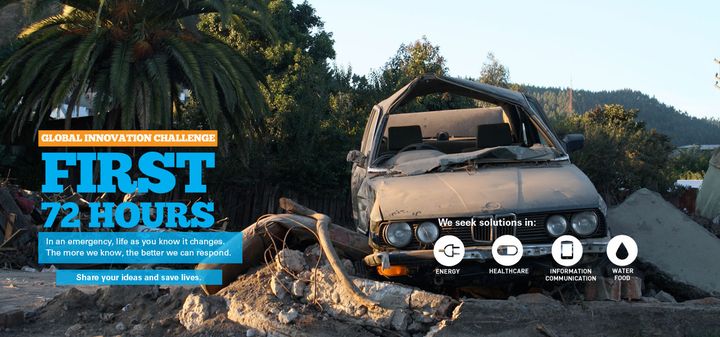
Last week, UNICEF and Socialab announced the finalists in their First 72 Hours challenge. The challenge was designed to address any of the various humanitarian needs that come in the crucial first 72 hours after a disaster.
From 278 submissions across 50 countries, they’ve nailed down their final six: a deployable telecom network from Sweden, an emergency check/backpack from Singapore, two water supply devices from New Zealand and England, an advanced stretcher from Argentina and a thermal imaging quadcopter from Colombia.
Reading about these projects, I was struck with the thought, “Why wouldn’t you make all those things? They’re all great ideas.” I guess that’s one of the side effects of challenges. They are designed to identify the best solution to a problem. But the innovation they spur goes beyond the scope of the challenge itself.
The six finalists in UNICEF/Socialab’s challenge exemplify this. Ultimately, 2 will win the challenge, but the other 4 still have legs. They’re still great ideas. They still retain the possibility of being applied.
And what of the other 272 submissions that were not selected as finalists? There are surely some good ideas among them that simply didn’t suit the criteria of the challenge as well as the 6 finalists. An initiative to provide counselling to those affected by disasters. A spoken language translator. A social media platform to drive critical real-time information.
Challenges can raise the tide for entire industries, not just for a feather in the hat of the winner. They can jumpstart careers, developing intellects, create well-oiled teams, restore a person’s faith in the future, and generate an unforgettable sense of achievement for participants.
The worst case scenario with any challenge is you tried to do something good for the world and you failed and all you have to show for it is the knowledge that you tried. There is no catch. That’s it. That’s literally the worst thing that could come from a challenge – you tried to make a difference.
See for yourself… HeroX just launched the ImagineX Challenge on this site to identify 10 challenges in the world. There are 10 prizes of $1000 each being given away to the Top 10 later this year. And all participants need to do is identify and submit challenge ideas.
There is no shortage of challenge ideas. You could scroll through your Facebook news feed to identify challenge ideas. You could walk down a street, observing your surroundings to identify areas for improvement. You could invite friends over for a night of brainstorming that could produce a whole slew of challenge ideas. And the next day you could brag about how you saved the world the night before.